Nearly 30 Years of Weaving And I Still Don’t Know “Jack”

We’re not total strangers, jack and I.  We’ve crossed paths.  Met briefly at a couple of workshops, and at a friend’s house.

I’ve read several descriptions.  And seen a lot of pictures.

But we’ve only ever had a passing acquaintance.  We’re certainly not good friends.  And the thought of spending any real time together?
It never crossed my mind.

Not until recently, that is.

Maybe because my first loom – a counter-balance loom  – seems like the perfect loom.  Small and sturdy.  Exactly the right loom for me.

I  learned  to love weaving with a counter-balance loom.

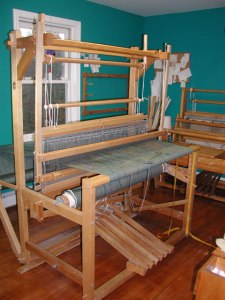
Photo of 27" Leclerc Counter-Balance loom
My first and favorite loom – a 27″ Leclerc “Fanny”

Maybe that’s why my second loom is also a counter-balance loom.
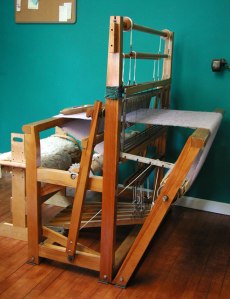
Photo of 36" Leclerc Counter-Balance Loom
My second loom – a 36″ Leclerc “Fanny”

And my third.

Photo of 45" Leclerc Colonial Counter-Balance Loom
My third counter-balance loom, a 45″ Leclerc Colonial

To me, these looms represent everything good about weaving.
Easy, effortless and enjoyable.

I’m happy weaving with these  looms  – and have great long  lists of  “what to weave next” – projects perfectly suited to weaving with a counter-balance loom.

So even though the 45″ (older) Leclerc Colonial is convertible – (and not just from counter-balance to jack, – I have the kit to add 4 more harnesses), – even though I could switch it over to a jack loom, – I’ve never been particularly interested in giving it a try.

Any discussion of counter-balance vs. jack  fell by the wayside.
Into the category:  “It doesn’t matter, it’s not important, and I don’t care”.

Until recently, that is.

Because recently I’ve had several conversations about looms.  Conversations with people in my Learning to Weave classes; conversations with weavers thinking about getting a different/smaller loom; conversations with people visiting during Open Studio Weekend; conversations about choosing the “right” loom, and which loom is the “best” loom.

And I’ve started thinking about how limited my weaving is.

When a question comes up about jack looms, all  I can say is:
“I don’t know”.

(For the record, I think “I don’t know” is a perfectly good answer.)

But all that thinking and not-knowing made  me curious.  Not just about why I was choosing not to know.  (Although that may be the more interesting question.)  I started to get curious about “jack”.

How would (my) weaving be different if I used a jack loom?

The Leclerc Looms  website  has good  information about the mechanical differences between counter-balance,  jack and countermarche looms – along with the advantages and disadvantages of each system.

But I wanted to know what it meant to me.
What did it have to do with the kind of things I like to make – or  the kind of fabric I like to weave?

Would having a jack loom change how I felt about weaving?  Could I, would I, should I – weave differently – or explore different things  if I had a different type of loom?  Was there something in particular I wanted to try, but couldn’t accomplish with a counter-balance loom?’

And the “ifs” turned into “then”  and “when”.
If I was considering converting the Colonial to a jack loom,  then I might as well set it up with all 8 harnesses.  And if  I was going to look for a learning project, then I might as well look for one  that  let me experiment with multiple harnesses.
When I found the right project I decided to give it a try.
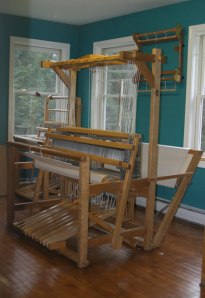
Photo of Leclerc Colonial Loom as 8 harness jack loom
My Colonial Loom with 8 harnesses.
After 2 months and three warps, I’m surprised and pleased.    The nearly completed project was a perfect introduction to “jack”.   And even though it represented just a little bit of time – (in weaver time) – it feels like time well spent.
Most of all, this experience  helped clarify something the Home Economist (Consumer Scientist?) in me suspected – something the Weaver in me needed to know for sure.

It’s not just about the loom.

Our personalities, values,  lifestyle choices,  likes and dislikes,  dreams, aspirations, goals –  all of those things deserve our attention.

The first loom you use may not be either “right” or “best”.  But if it gets you weaving, it’s a still a good choice.  It’s important to notice what feels like fun – and what doesn’t.

Keep weaving.  And pay attention. Weaving can show you things.
Whatever loom you use.

Your preferences will show up in the fabric.

Photo of various colors used in 8H weaving.
Changing weft colors made this an adventure!

I’ll tell you why this was such a great project in my next post.

Right now, with another 20 inches or so left on this (last) warp –
 I gotta go weave.

Joanne's blog signature, Pine Ledge Fiber Studio

Weavers: Do You Ever Want To Just Tie One On?

Not a dozen.
Not 4.
Not a complete “set” of anything.
No extras for friends, or gifts to give.
Not enough to donate or sell.
Do you ever choose to warp your loom for just one thing?

It sounds simple enough.
But it might not be all that easy – especially if it’s not what you usually do.

If you usually try to make the most of your weaving plan by making multiples, warping for just one thing seem might seem like a waste.

Why does it feel like one is not enough?

Maybe because your time is valuable.  And as a resource, it keeps dwindling.
When we’re short on time, but passionate about weaving  – we may feel the need to maximize our efforts.

It’s an economy of scale thing.
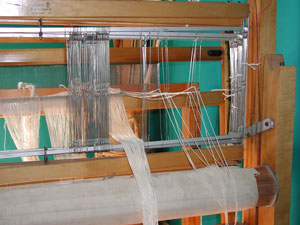
Warping a loom – getting ready to weave – requires a lot of preparation.  Measuring, sleying, threading, tying on, winding on…

Photo loom harnesses and heddles being threaded
One part of the warping process – threading heddles.

Whatever order you choose to do it in, –  it all has to happen – whether it’s to make one thing or to make many.

Each additional thing you plan to weave adds more length and uses more yarn.
But measuring and winding on only take a little bit longer.

Most other parts of the process stay the same.

So you’re actually saving time by making multiples – by not having to repeat all the steps.

Clearly, it’s more efficient to make more than one.

But … Are two enough? Are 6 too many?
When a TV ad posed those questions several years ago, the answer was obvious – because with prunes you really can ‘trust your gut’ to get it right.

When you’re planning a weaving project – sometimes it’s hard to see why more is not (necessarily) better.

Rigid Heddle weavers may have an advantage here.  Limitations imposed by the equipment prevent over-reaching.
My RH loom comfortably holds about 4 yards of warp.   I’m not tempted to set it up for 24 towels – because I can’t.

On my floor looms, weaving 2 dozen towels from one warp is definitely possible.  (But if you think this might be a good thing –  and if you  know you have a short attention span, and/or are easily bored, please – pause and consider –  by #7  the weaving starts to get old.  The next 17?  Not a lot of fun.  Trust me.)

How you feel about the warping process can make a big difference.

Especially if  you think of it as an ordeal.
Do you find it excruciating?  Or merely off-putting?
Does it seem like it takes forever?
Do some parts of the process feel awkward and uncomfortable?
Is it complicated and confusing?
Does warping your loom feel like a major undertaking?
Do you warp for more than one so you can avoid having to do it more often?

Do you wish you could warp less and weave more?

For a lot of weavers,  the work of setting up a loom isn’t the fun part – and that becomes a problem when there isn’t  a lot of time to spare.

But if we pay attention to what’s fun and what’s not fun – if we consider what we might do differently – we can find ways to make the not so much fun experience more satisfying and less of a problem.

Warping is part of weaving.  A big part.  One thing has to happen in order to “get”  to do the other.  (And those next 17 towels do have to be woven off before I get to warp for something else.)

So how do you feel about warping for (and weaving off) just one small thing?
Does the prospect make you happy and excited?
Or does it sound like a waste (of time and materials)?

What if you enjoyed warping as much (or more) than the actual weaving?

What if the time it took to set up your loom was just – time?  What if it was good time? Special, satisfying and rewarding time?

What would it take for you to feel you were making the most of it?

If you feel the need to make multiples of a project – is it because your weaving dreams include lots of things?

Or is there some other compelling ‘ought to, have to, must do’,  – driving your choice?

If the reason you’re hesitant to warp your loom for just one thing is because you’re uncomfortable with the process – if it feels confusing, if  it takes too long, – if  you need someone right there with you to help you, and you feel intimidated by all the steps involved:

Warping more and weaving less might solve the problem.

Sometimes it makes sense to tie one on.
Just one thing.

And weave it off.
Then do it again.
And again.
And keep doing it.

Try warping your loom for one thing at a time.
Practice the part of the process that (for many people) is problematic.
Give yourself a gift (of time) that allows for practice.  Lots of practice.

It won’t make you perfect.  But I’m pretty sure it will make you feel capable, comfortable and competent – with your own version of  ‘warp speed’.

You might find that you enjoy how slow you go.
Maybe even find it exquisitely slow.

I gotta go weave.

Joanne's blog signature, Pine Ledge Fiber Studio