Lightweight Cotton Scarves

Photo of hand dyed blue and natural cotton fabric on weaving loom
Hand Dyed Cotton, blue and natural, tied resist. Hand dyed and handwoven by Joanne Littler, Pine Ledge Fiber Studio

This is one of my favorite fabrics.  It’s 100% cotton and hand dyed to create a random plaid effect.   And it’s fun to weave because the pattern is so irregular.  Areas of color and no-color seem to appear out of nowhere with each pass of the shuttle.

Finished  dimensions:  78″ x 13  1/2 “.   What I would call a wide scarf.  It works well as a pulled-through-the-loop neck piece and equally well as a narrow shawl.

The same lightweight cotton yarn is also quite beautiful in its natural, un-dyed state.   Against the dark background you can see the thick and thin threads crossing each other –  creating pattern in this plain weave fabric.
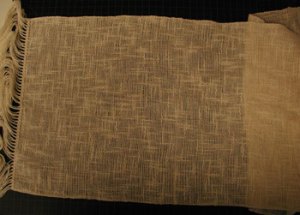
Photo of woven fabric, natural cotton, with slub yarn creating plaid effect.
Pattern created by the yarn itself, 100% cotton, woven by Joanne Littler, Pine Ledge Fiber Studio.

I’ve woven two of these  natural color pieces to sample for length.  One will remain as-is and the other I plan to dye.
Joanne, Pine Ledge Fiber Studio

Why Handspun?

Handspun Handwoven Cashmere Silk Shawl
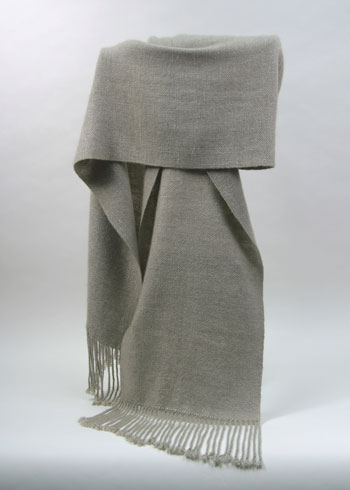
Cashmere and Silk Shawl, 84" x 13", Handspun and Handwoven by Joanne Littler

Handwoven cloth is pretty special all on its own.

Sometimes pretty.  Often remarkable.  Possibly spectacular.

But always, always special.

Using yarn you’ve spun yourself in your weaving, can change your fabric from special to downright unbelievable.

Really.  Tell someone (provided it’s true) that you used a spinning wheel to make the yarn for your handwoven  fabric.

Chances are, unless you’re surrounded by spinners and weavers at a fiber arts gathering,-  that person will gaze at you in disbelief.  They may not immediately understand, and they may appear puzzled.

Which gives you the perfect opportunity to share.

Whip out a picture of your spinning wheel, let them feel a bit of the fiber, hand them a skein of the yarn you made.  Use your words to explain how it works.

You can change the impossible, fairy tale thing they’ve only seen in a museum into something that seems a little more real, maybe even … possible!

I’m willing to bet they’ll be impressed.

Why does that matter?

Why would you bother?

I’d love to hear what you think.