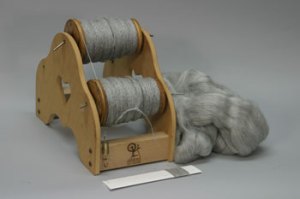
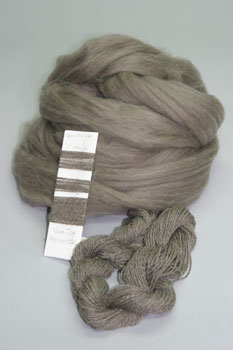
These are the first two bobbins spun from a new-to me Silver-Gray Alpaca and Silk blend from Ashland Bay.
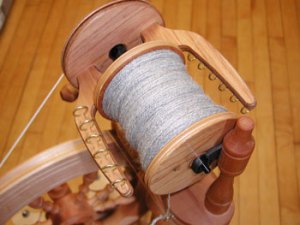
Made into a 2-ply yarn.
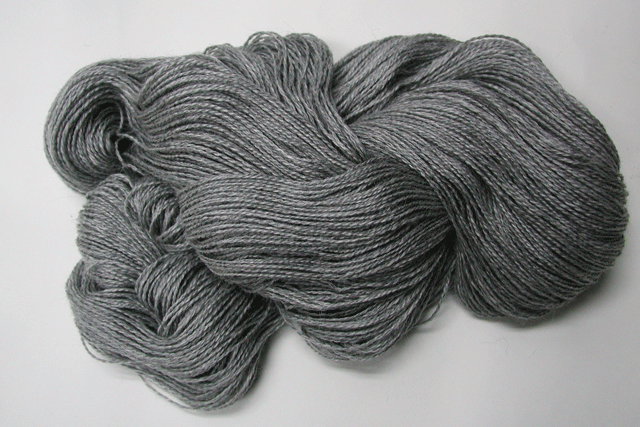
And wound-off into a 6.45 oz. skein measuring 694 yards (after washing and setting the twist).
My plan is to weave a shawl. I want at least 1200 yards of yarn. Based on an earlier piece, I weighed out 10 ounces of fiber.
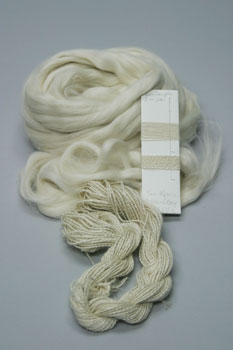
But the yardage in this first skein came up short – even though the diameter is fairly consistent. (The folded index card in the first photo holds the sample I use for comparison as I spin.)
So now, – with an actual number of yards per ounce in this first skein, – I know I need to weigh out more than that original 10 ounces of fiber.
This is not a surprise – it’s one of those ‘truths’ my left-brained spouse challenges when I say these things out loud: silk weighs more than alpaca.
And yes, I know that a pound of feathers weighs the same as a pound of lead.
But – the addition of silk to a fiber blend adds more weight to the finished yarn, making it heavier than a similar yarn spun from 100% alpaca or 100% wool or 100% cashmere.
Which means – when comparing yarns of the same diameter, twist, etc. – the silk blend will have fewer yards per ounce.
And my estimate of how much fiber to spin came from a similar project, but different fiber.
I include these numbers on my Weaving Record Sheet in big, bold, colorful ink – (along with a note next to the sample card in my Spinning Notebook).
So the next time I decide to spin this or a similar Alpaca/Silk blend for weaving, I’ll have a more accurate estimate of how much fiber I’ll need – (provided I intend to make a similar yarn – and – bother to look over previous record sheets).
Does this sounds like too much information?
Maybe it is.
But it satisfies my need to know.
Do you have a notebook of your past spinning, weaving and dyeing projects – or pages full of ideas for future projects? How much and what do you keep track of? Is it a help or a hindrance?
I welcome your input.

 Pine Ledge Fiber Studio