
Taking Leave

Photo of daffodils & study tools
Restful Study Flowers

It’s official.
For the 2012 season – this summer market season –  I’m off.
My market experience will be as a customer this year.

Technically, I’m on sabbatical – with a booth space reserved for 2013.  And (no surprise) the current relationship I have with Webster’s Dictionary compelled me to look that word up.

Webster tells me sabbatical is an extended leave – for “rest or study”.
I intend to do both.

Rug making, rep weave, and  log cabin designs have my attention at the moment.

Several new-to-me yarns from Henry’s Attic are making their way into project plans.

Ashland Bay has new fiber I’m eager to spin and weave – especially the new colors in their merino-silk blend  –  likely additions to my line of shawls and scarves.

And with warmer weather on the way I’ll be moving outside with dyes: trying out a few new techniques and applications;  fine tuning some of the color combinations I like best; and practicing on my handwoven fabric.

At the same time I’m continuing to review, renew, re-write, re-weave, and re-work several Rigid Heddle projects – hoping to give students in my Beginning Weaving class some additional choices and offer some of these new projects to a larger audience of RH weavers.

I’m also trying to develop a better working knowledge of how to use and maintain a website/blog.

As for vending at the Burlington Farmer’s Market, it means I’m not.
Not this summer.
And not having to wake up at 4:15 Saturday mornings?  That’s part of the “rest”.

This summer I’m looking forward to shopping there.
More than a quick dash away from my booth.
An actual jaunt.
Maybe even a saunter.

I’m looking forward to seeing how the new ‘footprint’ of the market works for both customers and sellers.  This larger space includes a section of St. Paul St.-  closed to traffic – with vendors lining both sides of the street.

More space means more vendors – 90 this year!   Vermonters selling what they grow and make – fresh produce, meats, cheeses, beverages, prepared foods and handmade crafts.  The market keeps growing – changing, improving and expanding – bringing more good things into the mix.

Better and better.  Every day  in every way.

And that sentiment is guiding my choice as I take my leave this year.
It’s time for me to look forward and include more good things in my spinning, weaving and dyeing – things I can share with an incredible group of individuals who enjoy, encourage and support the work.

I appreciate the opportunity.
And promise to post my progress.
Joanne's blog signature, Pine Ledge Fiber Studio

What’s In Your (Handspun) Stash?

If you’re considering weaving with your handspun yarn –
If  you think weaving might be a good way to use up some of the growing collection of yarns  in your stash –
You might also be wondering which (if any) of your handspun yarns are suitable for weaving.

So how do you find out?
You could grab a few skeins, start weaving and see what happens.
And choosing an impromptu, spontaneous approach might work for you – it might even lead to some unbelievably fabulous fabric.

But if you’re familiar with weaving, you’ll probably agree:  It takes a considerable amount of time to prepare.

And it’s not just about getting the loom ready.

Choosing the right yarn for the project and calculating how much yarn you need are significant steps in the process.

When you decide you want to try weaving with your handspun yarn – you need to know what you have.  Take a good look at what’s in your stash.  You may want to begin by sorting and analyzing – matching colors and characteristics but I think there’s something else to take care of first.

Pick up a skein of your handspun yarn.  Can you look at it and immediately say without question what type of fiber it is and how many yards of it you have?

If not, no matter how soft or strong, thin or thick,  no matter how beautiful (or ugly) you think your handspun is, – if you don’t know what it is and how much you have, the yarn isn’t ready.  Not ready to choose (or sort, or determine whether or not it’s suitable) – and not ready to use.

My advice – if you’re not doing this already – start labeling your skeins.

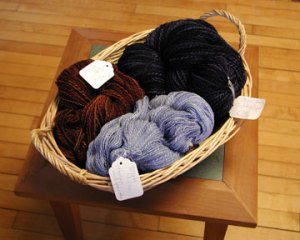
Photo of handspun yarn skeins using string tags as temporary labels
Some of my handspun yarn labeled and ready. Next stop: a storage bin labeled "Handspun Yarns for Weaving"

Whether you’re weaving with yarn strictly from your stash or you’re willing and able to augment your supply from another source, it’s in your best interest to have a way of recognizing what you have – before you try to figure out what to do with it.

Sometimes you can alter the project to ‘fit’ the yarn.  Sometimes you can make more yarn to fit the project.  But either way, you need to start where you are – and part of that is knowing (and understanding) what you have to work with.

If you don’t (yet) have a way to attach important information to your skeins of handspun yarn consider this: every time to handle those skeins, every time you consider whether or not it’s ‘suitable’ for a project, the same question comes up – what (exactly) is it, and how much of it do you have?

Why not eliminate that question and move past wondering?

It doesn’t have to be a big deal.  If you’re looking for a quick and easy, inexpensive way to label your skeins, try these:

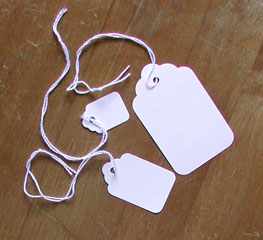
Photo of string tags used to label handspun yarn skeins
String tags are an easy and inexpensive way to label your skeins of handspun yarn.

String tags are your friends.  Buy some or make your own.

I use string tags on all my handspun skeins.   And because I only attach one of these tags after the skein is finished – (wetted or washed, twist set, skein dried and yardage re-measured) the presence of a string tag on one of my skeins is like a big (or little) white flag that says “ready”.

Ready to use, ready to label for sale, or ready to save/store for later.

The information on these tags might only include yardage after finishing, dry weight and fiber type – but that’s enough for me to compare what I have, to what I need, for what I want to weave.  Any other information I choose to keep is recorded  in a separate spinning notebook.

Labeling deserves a place in your spinning routine, however you plan to use your yarn.

Think of it as a gift to yourself.  Having the information you need – right at your fingertips – can save you time in the long run.
Time you might rather spend spinning and weaving.

So – How do you know what’s in your handspun stash?

Joanne's blog signature, Pine Ledge Fiber Studio