Some Spinners Just Want to Have Fun

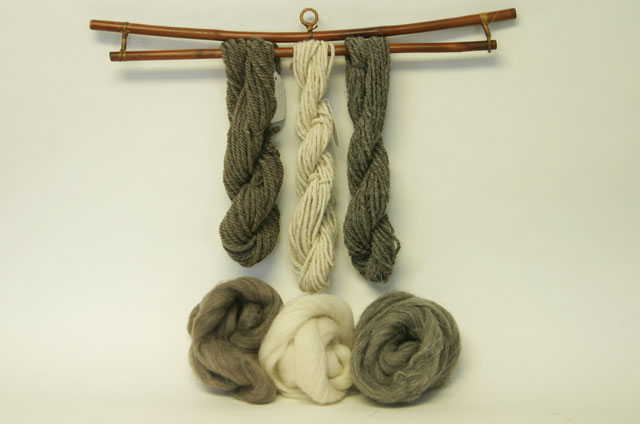
Photo of 3 skeins of yarn and their starting fibers, handspun by Joanne Littler, Pine Ledge Fiber Studio, Fairfax, VT
Spun for Fun
3-ply wool yarns handspun by Joanne Littler

When you sit down at your wheel to spin –
You don’t have to know what you’re going to do with your yarn.
You don’t have to have a project in mind.

You don’t have to understand the meaning of twist and grist.
You don’t need to know your flyer to wheel ratio.

You don’t need to know what breed or type your wool is.
Or where the cotton came from.

Some spinners do.

Some spinners start out with a need to know all of those things
(and much, much more).
Some spinners develop an interest in the “technical” side of spinning after they’ve been spinning for a while.
Some spinners learn to use particular bits of information to suit their needs.
Some spinners focus their attention one type of fiber and become experts in that area.

And some spinners don’t.

Sometimes spinners just spin for fun.

All the details, facts and figures don’t matter one bit.  And they might never do. Because they don’t have to.

Because spinning – all by itself – for no particular reason – is fun.
Relaxing.  Satisfying.  Pleasurable.  Off in your own world – creative, happy, mind-blowing honest-to-goodness fun.

However you come to it, whatever you do with it, wherever it takes you – whatever it looks like to anyone else – Somehow, some way, at some level –

We’re all doing it because it’s fun.

We don’t have to pay our taxes in yarn.
(FYI the American Revolution wasn’t only about tea).
We don’t have to make yarn to clothe our families and ourselves.

We spin because we enjoy it.
It floats our boat.
Knocks our socks off.
Takes us away.

Maybe not at first.  Those first few minutes (and hours, and days) of struggling to coordinate hands and feet, fingers and fibers – those moments feel frustrating and tense.
So you walk away.
You take a nap.
And you come back and try again.

Your desire to spin — if anyone asks – may be hard to explain.
Because maybe you don’t know what you’re going to do with your yarn.
Maybe you don’t know for sure which part is called the flyer.
And maybe ratio sounds too much like math.
Maybe you don’t know the difference between protein fibers and cellulose.
And maybe (at least for now) you don’t care.
You just want to spin. Just for fun.

If you choose hand spinning as a way to spend your time, you’re choosing an activity that many people think of as old-fashioned, unusual, unnecessary, and  – different. Maybe even weird.  And yet, you’re choosing it anyway.

Maybe you feel that “it” has chosen you.   Drawing you in, opening up a whole new world of “wonderfulness”.

No matter where you are – new to the craft or an old hand at it – sometimes it seems like there’s so much more to learn, so many interesting avenues of discovery, so many talented and creative people offering encouragement and advice – it almost seems like too much.

Maybe it is.  And maybe that’s the good news.
Maybe that’s when you know it’s time to sit down at your wheel.  Pick up whatever fiber is handy and just spin.  See where it takes you.
Relax.  Enjoy.  And have some fun.

I gotta go spin.
Joanne

8H Weaving Practice = Holiday Greeting Cards

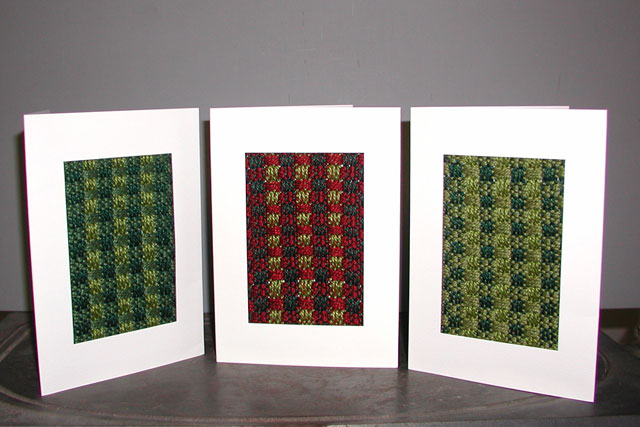
Photo of Greeting Cards with Fabric Inserts Handwoven by Joanne Littler, Pine Ledge Fiber Studio
Handwoven Greeting Cards – 2012

These greeting cards are the result of a self-directed learning spree – a hands-on, trial & error, teach-myself excursion into the unknown.  In this case the unknown was weaving with an 8-shaft loom.

2012 is the third year in a row I’ve made greeting cards using pieces of fabric from one of these binge-on-a-whim experiments.

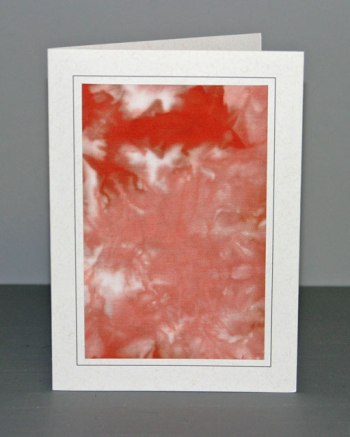
In 2010, my first handmade cards came from practice mixing dye colors.

Photo of Greeting Card with  hand dyed fabric insert by Joanne Littler, Pine Ledge Fiber Studio, Fairfax, VT.
Hand Dyed Greeting Card 2010

One young friend asked if I’d woven the fabric (which I had not), so the following year I decided to weave fabric for cards as “practice”.

Practice weaving a specific shape – 6.5 inches x 4.5 inches with an area of interest approximately 4.5 inches x 3 inches.
(I use cards from Photographer’s Edge)
And practice weaving stripes.

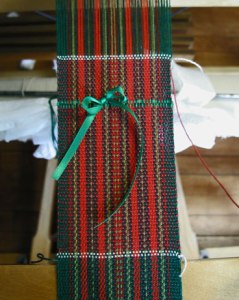
Photo of red and green striped fabric for Holiday Cards on the loom - woven by Joanne Littler, Pine Ledge Fiber Studio, Fairfax, VT , 2011n 2011
Striped fabric for holiday cards – 2011

No surprise.  I learned a lot.

A lot of important stuff.  Like why I prefer putting stripes in the warp rather than the weft.  (It’s easier.)  And why I’ll think twice before choosing to weave  weft-faced stripes.  Especially if the yarn I want to use is 8/2 cotton. (It takes forever).

On the other hand, I also (now) know that I love the look of weft-faced stripes in 8/2 cotton.

Tough call.  But good to know.
The kind of knowing that comes from doing.
A fine tuning of personal preference.

Fabric for greeting cards is a perfect project for practice.

And now one of my “go-to” projects when I want/need to psyche myself out.
(Or up).

When the best way to get answers to my questions is to try, re-try, do, redo, repeat, adjust, and try again.
When information gathering is part of the plan.
And when I need a way to get past that gag-me-with-a-spoon reaction I have toward making samples.

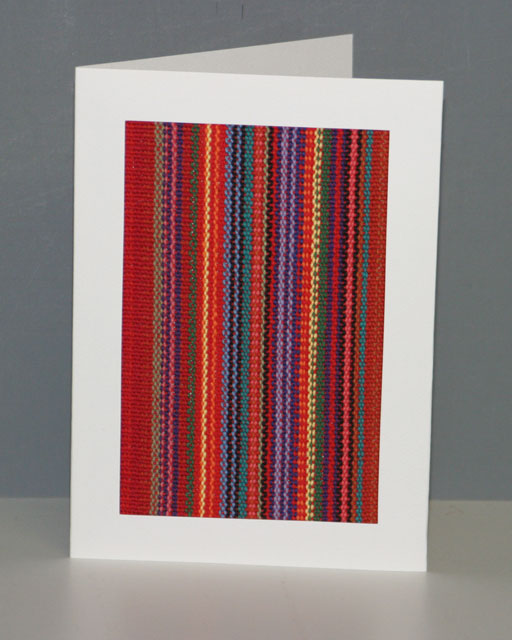
Photo of striped fabric greeting card by Joanne Littler, Pine Ledge Fiber Studio, Fairfax, VT
Just for fun stripes

The prospect of working on anything that resembles a “put-it-in-a-notebook-and forget-about-it” weaving sample leaves me totally uninspired.

Wholehearted, enthusiastic exploration of possibilities is much more likely to occur when the process is exciting and the results
hold meaning.

Weaving is most meaningful to me when I’m working on something I can use.

That’s why, when I started thinking about switching my Leclerc Colonial loom from 4 to 8-shafts, I knew I had to find a way to make the weaving worthwhile – as in, “this absolutely has to be something I can have fun with and use”.

The problem was (is?) – nothing I want to weave requires 8 harnesses.

So I went to my back issues of Handwoven Magazine  – starting with the most recent. Paging through this vast collection of weaving wisdom usually moves  me.  But I knew what I was looking for – and none of the projects requiring 8 shafts were “it”.

Maybe this says something about how far behind I am, compared to rest of the weaving world.

Nothing resonated.
Until I got back to 2001.

Sure enough, in a magazine published 11 years ago, (pages 48 – 50 in the September/October 2001  issue of Handwoven ) I found the perfect project.

Designed by Sarah Saulson – specifically aimed at and written for 8 harness “newbies” (part of her “Now we are Eight” series of articles), – and intended as a “how-to” for weavers interested in creating plain weave selvedges along the edges of a woven pattern, it was exactly what I was looking for.

The project was for mug rugs.  Small, simple and manageable.  These little gems – (also known as coasters) – have never been on any of my weaving “to do” lists.   Remember when I mentioned the “need to weave” something I would use?

But – what if?  What if they were just a little bit narrower and each piece woven a little bit longer?  What if the fabric could be woven to fit in the window of a greeting card?

There it was.  The project that inspired questions suitable for a “spree”.  Thanks to Sarah Saulson and Handwoven Magazine,  I was ready to find out what would happen “if” with 8 shafts.

It was late October when I started weaving – not soon enough for people to see during Fall Open Studio Weekend, – and perhaps overly optimistic of me to imagine weaving off, finishing and sending out  few Happy Thanksgiving cards. But the autumn-y brown and gold colors I chose for warp made an excellent foundation for a whole slew of color combinations to try in the weft.

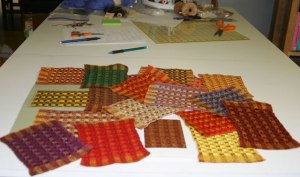
Every one was different (and  a couple of them were really different).

Photo of different color combinations made by changing weft colors on a brown and gold warp.  Handwven by Joanne Littler, Pine Ledge Fiber Studio, Fairfax, VT.
Changes in weft colors on a brown and gold warp.

But exactly the kind of “see and do” thing that could keep me interested. Interested enough to make me want to repeat the process.

As soon as I finished the first warp, tweaked the weaving plan and made adjustments based on my notes, – I started all over again.  Different warp colors and another whole slew of color combinations to try in the weft.

So maybe three times really is the charm.  Because after 3 separate warps, I was feeling a lot less beleaguered by those additional shafts and treadles.

Baby steps, to be sure – but enormously satisfying.  And with lots of cards to give as gifts or  send in greeting – the experience fit perfectly into my idea of worthwhile.

Worthwhile enough to make me stick with 8?   No – I’m just not there.  Too many other things to do.

The Colonial is back to normal – which for me, means a 4-harness counter-balance loom with an overhead beater.   And with several exciting prospects on my “things to weave” list, – I probably won’t need to dig through my back issues of Handwoven Magazine for at least another 6 months.

In the meantime, since I had to resort to giving someone one of my weaving IOU’s instead of an actual gift this year –

I gotta go weave.

Joanne's blog signature, Pine Ledge Fiber Studio