Open Studio Weekend, May 25 and 26, 2013

Logo used for Vermont Craft Council's Open Studio Weekend events

Looming on the horizon (pun intended) – Vermont’s Open Studio Weekend – is in its 21st year – and represents  long hours of hard work and preparation for everyone involved – especially the  dedicated board members and staff at the Vermont Crafts Council .  These folks deserve special thanks for attending to a myriad of details that go largely unnoticed. (You know who you are – thank you, thank you, – thank you!)

On Memorial Day weekend, visitors will come to our studios from all over Vermont, parts of New York,  New England, Canada and beyond. Craft and art enthusiasts show their support – and satisfy their curiosity – by making Open Studio Weekend part of their holiday plans.

Some people get a copy of the map and choose their route ahead of time – eager to see particular types of work,  and meet certain artisans.

Some people just hop in their cars and look for our strategically placed (?) yellow signs.
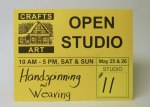
Photo of VT Open Studio sign

And some people see the signs – have no idea what it’s all about – but are brave, (curious? adventurous?) enough to come in and find out.

Whether you’re from “away” or just up the road the effort you  make to stop in, say hi, look around, ask questions and generally take an interest in what we do – that’s what it’s all about.

Open Studio Weekend is an opportunity to share our enthusiasm for craft and art – from both sides of the loom – or lathe, or quilting frame or easel or wheel or camera or kiln.

It’s when we explain a process and see someone’s face light up.  It’s when we hear people say  “I can’t believe you do that” or ” I never knew that’s what happened”.

It’s when we demonstrate our tools and equipment – and  (maybe, if it’s safe) let people try it for themselves.  It’s when someone says “I’ve always wanted to do that”  – and they can.

For some of us, getting ready for Open Studio Weekend means sending email to each of the 242 participants with reminders to:

  • pick up your materials
  • keep your dog(s) occupied elsewhere
  • weatherproof your signs
  • put your signs out just before the event (and take them down immediately after!)

It means spending money for ads in local papers and on public radio.

It means asking local shop owners for permission to put up posters and leave a few maps.

It means sending invitations to people on our contact lists, and maybe including a first look at what we’ll be offering in a special weekend sale.

It means cleaning up and clearing out – to make a space that’s “visitor-friendly”.

It means having examples of our work available to bring outside and show to someone in their car if they’re unable to come into the studio space.

It means a lot.
I think it means there are a lot of people who care about art and craft.

People with a profound belief in the value of craft and art education.
People who are willing to actively support events like Open Studio Weekend.
People who are willing to show up.

I gotta go get ready.
Joanne's blog signature, Pine Ledge Fiber Studio

It’s Plying Time Again – I’m Gonna Weave You

Eventually, yes – weaving is the plan for these yarns.

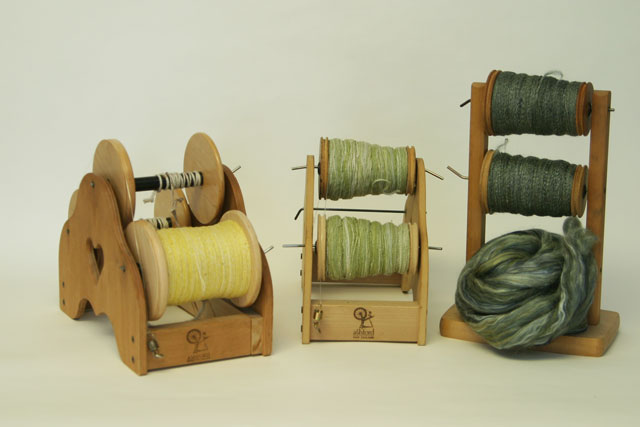
Photo of yarns on spinning bobbins, 2-ply and single cotton and single silk/merino, handspun by Joanne Littler, Pine Ledge Fiber Studio, Fairfax, VT.
Two done, four to go.

But that’s not the reason why I had to ply.

I needed some empty bobbins.   I got myself into a bit of a pickle spinning new-to-me fibers and  ‘forgot’ that in order to make a 3-ply yarn, I would need one bobbin for each ply.  1+1+1 = ?  (Arithmetic – sheesh!)

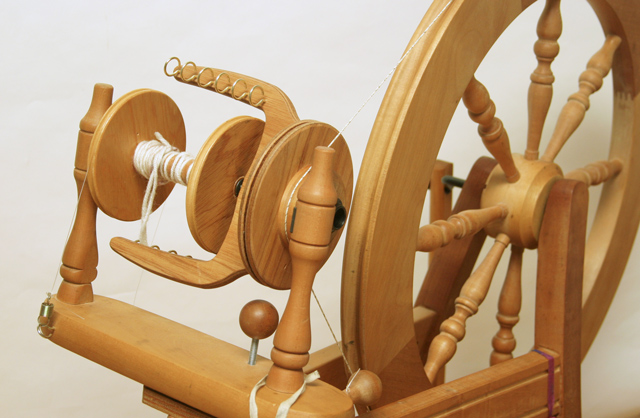
The thing is, until recently, my preference (my habit) has been to make 2-ply yarns.  With 2 empty standard size bobbins and a jumbo flyer

Photo of the older version of a Jumbo Flyer on an Ashford Traditional Spinning Wheel at Pine Ledge Fiber Studio, Fairfax, VT.
(older) Ashford Jumbo Flyer on an Ashford Traditional Spinning Wheel

I always have a way to make two bobbins full of singles and ply them onto the jumbo bobbin (plus the added bonus of one big skein/no knots).

But there are differences between Cashmere and the so-called “rug wools”  – beyond the most obvious.  And I’m curious about what it takes to make warp for a rug.  So I decided to explore the potential of having an additional ply (and got pretty excited about the possibilities).

But lo and behold – all my so-called ‘extra’ bobbins were otherwise engaged.

It’s not unusual for me to have several bobbins of spun singles waiting to be plied.  It doesn’t bother me to let them sit there until I’m ready to take them to the next level.  And I like looking at them – all proud and pretty on their lazy kates.

But it’s not considered best practices.

Fibers twisted together (yarn) and wound under tension (into a ball or around the core of a bobbin)-  over a period of time – may appear to have lost their characteristic elasticity.  And appearance is key – because it becomes  difficult to accurately gauge the true nature of that fiber or yarn as it appears in it’s stretched-out state.

What that means is – I might not be able to tell how much plying twist I’ll need just by looking at the singles that I’ve oh so carelessly left sitting on their bobbins for who knows how long.

But here’s the thing.
In my experience, based on what I know about the yarns I spin –

Leaving singles on a bobbin is not the problem.

The question of whether or not it’s “good” for my yarn gets filed into a category I call:  “not important, doesn’t matter, and I don’t care.”

If you’re having a whole lot of fun spinning and spinning – and spinning – you may wind up with a bunch of spun singles and nowhere to move them.

The problem is not having any empty bobbins.

When you’re enthusiastically engaged and eager to continue along a particular creative path (like spinning), it seems to me that “best practices” include being able to keep doing what you’re doing when you’re on a “roll” rather than lose your momentum, or worse – feel frustrated at having to stop.

You don’t have to be afraid that your singles will languish if you leave them on a  lazy kate for a while.  It’s OK to let them wait their turn if you have something better (more important, different or exciting) to do.
Develop your own best practice.
Get into the habit of writing down where the drive band is when you spin. (Which whorl are you using?).
Be aware of your natural treadling pace and drafting style.  (How many times do you push down on the treadle before your newly formed yarn moves through the orifice and onto the bobbin?)

Write it down. Those little bits of information will help you pick up where you left off.

Sometimes what feels like an interruption turns into a good thing.

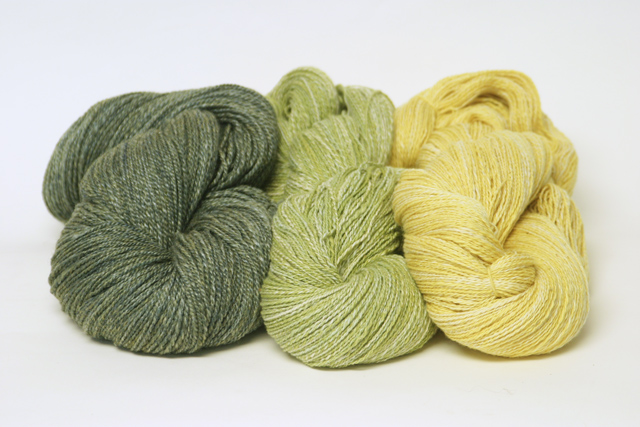
Photo of 3 skeins of 2-py yarns, handspun by Joanne Littler, Pine Ledge Fiber Studio, Fairfax, VT
2-ply yarns handspun by Joanne Littler

Now I have 6 empty bobbins.   Maybe it’s time to try a 4 or 5-ply?
Nah.

Now I gotta go weave.

Joanne