Weave With What You Have

Ribbon Yarns and Plastic Bags
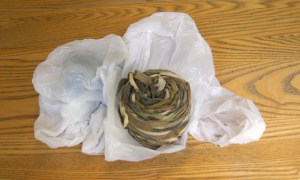
Photo of a ribbon yarn on a plastic grocery bag .
Reduce, re-use and recycle.

At first glance, neither of these two things looks much like the other, and it’s hard to imagine any characteristics they might share. But thanks to some inspiration from a weaving friend along with information gleaned from this free down-loadable project –  it turns out these very different materials  do behave a lot alike.

The original project, designed by Anne McKenzie, is for a tote bag – using handwoven fabric made with weft strips cut from plastic grocery bags.  And it’s a brilliant way to reduce, reuse, and recycle those ubiquitous, fly-away pieces of trash most stores try to give us  with everything we buy.

My friend Barb showed me the two tote bags she’d made using the directions she’d downloaded from Weaving Today. One of her bags was woven with plastic grocery bag strips as weft/filler – the other was woven with strips cut from the bags she gets with pellets for her wood stove.

And as soon as I read through the “project-at-a-glance” and touched/handled the fabric Barb had woven, I knew it held an answer to two of my current weaving questions:  What do I need to do to make a tote bag? and How can I use up some of the ribbon yarn I have on hand?

This project didn’t just speak to me – it shouted DO IT!
So I did.

Photo of Tote Bag made by Joanne Littler, Pine Ledge Fiber Studio, VT - using Deco Ribbon as weft.
Handwoven Tote Bag made by Joanne Littler, Pine Ledge Fiber Studio, Fairfax, VT.

My version is not nearly as interesting as Ann McKenzie’s original.  I wanted to experiment with construction as well as fabrication so I left out the inserted handles – opting for sewn-on handles;  modified the size and shape; turned it around so the fold is at the bottom and both sides are sewn; and I used 100% cotton yarn for the warp with  Deco Ribbon from Crystal Palace Yarns as weft.

I’ve asked a few of my former weaving students to double-check my notes – if it works for them, I’ll post the details here.

In the meantime, – if you haven’t yet taken advantage of what Weaving Today has to offer, you might want to check it out.  Lots of information and inspiration worth sharing with your weaving friends.

I gotta go finish sewing my second bag.
Joanne's blog signature, Pine Ledge Fiber Studio

Do You Have What It Takes To Make Superior Yarn?

Spoiler alert.
Handspinners please note.
If you’re not interested in making better yarn – leave now.
Click away.
Do not read the rest of this post.
Because what comes next will change the way you think about your handspun yarn.

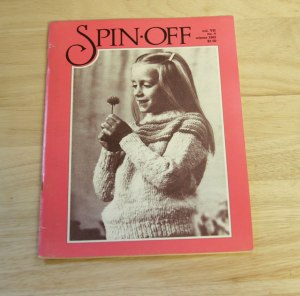
What comes next is a not-so secret formula – written by Lee Raven and published in the Winter 1983 issue of Spin-Off Magazine.

Photo of Spinning Magazine from 1983
It’s both a how-to and a challenge.
It’s a simple equation – and it’s a doozy:

“Good Fibers + Skillful Control = Superior Yarn”

And by doozy I mean game changer.

Because if you read those words and think about how that statement applies to the yarn you make, you’ll start thinking about yarn differently (and not just your own yarn – you’ll probably think differently about commercial yarns, too).

So if you ignored the warning at the beginning of this post, be aware of the consequences.

Everything you know about fiber, yarn and spinning has undergone a subtle but undeniable alteration.

Your brain has begun to reorganize and re-frame all the information you’ve gathered about making yarn –  including what you do, how you do it and what you think about the end result.

You might not recognize the change right away.  But it will begin to show up in the questions you ask.  Questions you might not have asked yourself until now.

Questions like:

  • “What qualities define a good fiber?
  • Are the fibers I usually spin considered good fibers?
  • “What makes some spinning fibers good and others not so good?”
  • ” What do I need to know about fibers so I can tell if they’re good fibers or not?”
  • “What does skillful control mean?”
  • “What skills do I have and how can I modify what I already know?”
  • “What is it – exactly – that I’m supposed to control?”
  • “What skills and techniques can I practice to gain more control as I spin?

If you continue to seek answers to questions like these – and if you incorporate what you learn into the yarn you make, – you’ll know if you have what it takes to make superior yarn.

Let your questions – and your preferences – lead the way.

Maybe you’ve  been wondering how to change something about the yarn you spin – how to make it thicker, thinner, smoother, or more textured?.

Maybe you’d like to try spinning something different – something you’ve heard other spinners say is too hard, or too tricky or too expensive.

Maybe you want to weave with your handspun yarn.

Maybe you want to raise your own sheep but aren’t really sure what breed is best for your purposes.

Maybe you don’t give a rodent’s patootie what someone else thinks is “superior” – maybe you just want to be able to make whatever the heck kind of  yarn you want to make.

So what’s stopping you?
What do you need to know before you can move forward?
What part of that equation don’t you understand?
(I’ll tell you about some of the things I didn’t – and still don’t – understand in another post).
But right now – I gotta go look through a few more of my old Spin-Off magazines.

Joanne